
September Ashrei Insights Webinar Recap
Ashrei believes data is not just about numbers, it’s about people, families, and communities. When we look closely at what data is telling us, we can better understand where harm is happening, where support is needed, and where opportunities for change exist. That is the purpose behind the Eastern Missouri Immigration Enforcement Data Dashboard and the monthly updates we now share through our Insights series.
In the first of our webinar series in September 2026, Ashrei Executive Director Sara Ruiz shared a review of the August 2026 dashboard, looking at what the latest numbers tell us about immigration enforcement in Missouri and how those numbers fit into the larger national picture. We also shared an early look at new data on medical concerns in detention, collected through screening tools developed by our summer fellows.
Watch the full webinar:
August by the Numbers
📞 79 new contacts came into the Rapid Response Hotline in August.
👮 56% of reported ICE detentions began with local police involvement.
📈 The bigger picture: Enforcement activity dipped slightly in August, but the decrease follows the peaks and valleys we have seen since January 2025. Looking at the data over time, the overall level of enforcement in our region continues to be significantly higher than it was at the beginning of 2025.
The Hotline data is also consistent with broader trends reflected in national sources, including ICE administrative arrest data analyzed by the Deportation Data Project and detention population data from TRAC.
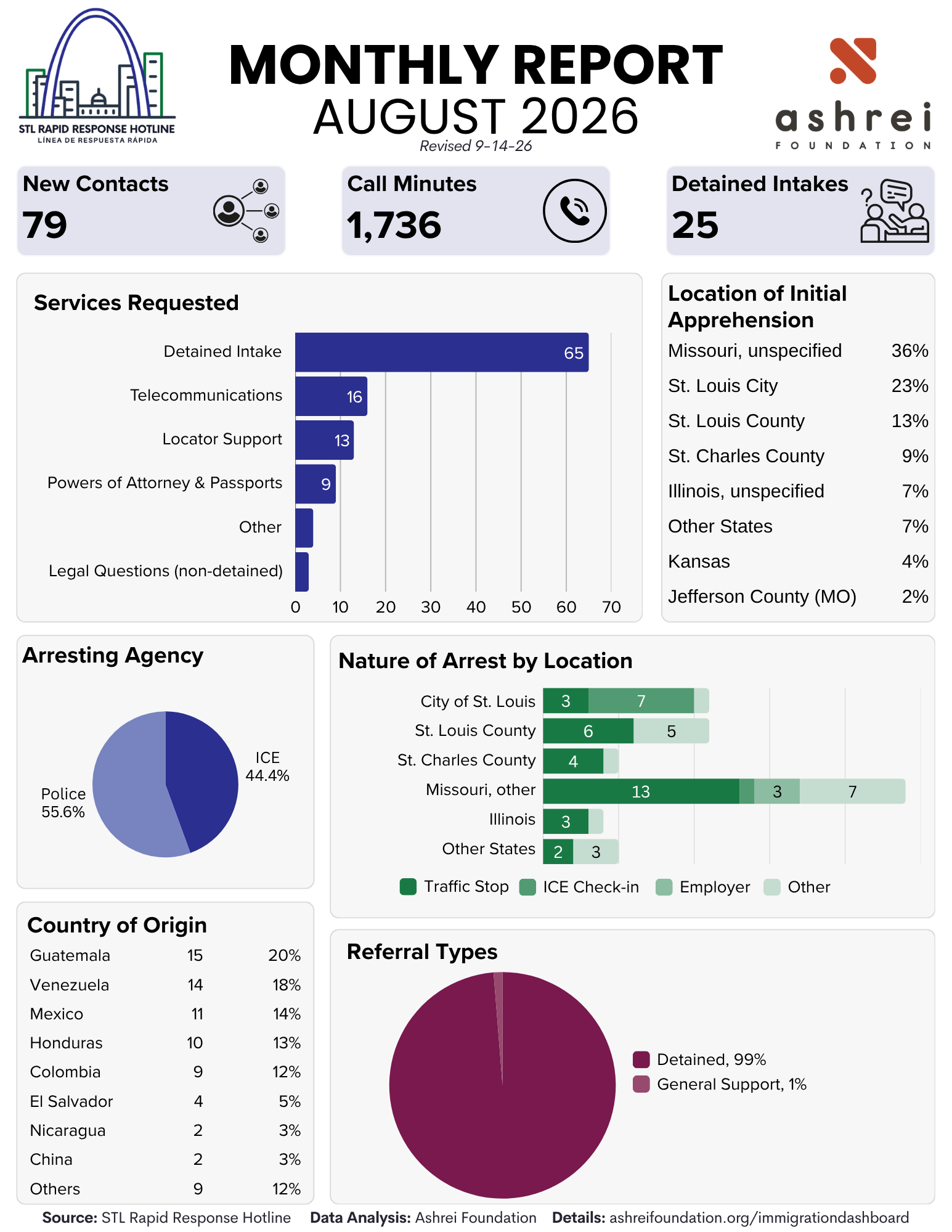
August 2026 Eastern Missouri Enforcement Dashboard
“Numbers don’t tell the whole story. There are actual stories and names and faces of people that are every single one of the ticks and marks that you see in these graphs.”
Every call represents someone trying to navigate an unfamiliar and often frightening system. Every detention represents a family making decisions, finding information, and trying to stay connected. The data helps us see patterns, but the people behind those patterns are what keep us focused on why this work matters.
What We're Seeing:
Missourians need transparency.
Local law enforcement continues to play a significant role in immigration enforcement in our region, including departments with and without active 287(g) agreements.
As of September 26, 2026, Missouri had 156 active 287(g) agreements, about 6% of the 2,589 active agreements nationwide. That placed Missouri fourth nationally, behind Texas, Florida, and Arkansas. Nine agreements were active in the St. Louis region.
The reach is broader when we consider the ten municipalities that participate in the North County Police Collaborative. Together, these agreements and participating municipalities touch 19 localities in the region, representing roughly 20% of localities and more than 30% of police departments.
But the data also raises a larger question: where does immigration enforcement actually begin?
As Sara shared during the webinar:
“Local police are heavily involved in immigration enforcement in Missouri. That's also true regardless if they have an active 287(g) agreement or not. For instance, 77% of arrests in St. Charles County that led to ICE detention began with a traffic stop. That tells a really clear, in my opinion, story about where our advocacy efforts are best positioned to interrupt the harm that we see happening in our community.”
Understanding where enforcement begins can help communities better understand where intervention, accountability, and policy change may be possible.
People deserve clear information about how local law enforcement is participating in federal immigration enforcement, what that participation looks like in practice, and what impact it has on families.
Missourians need access to information.
For families impacted by immigration detention, access to accurate legal information remains one of the most urgent needs we hear through the Hotline.
The St. Louis Rapid Response Hotline is available from 7 a.m. to 7 p.m., seven days a week. Volunteers help families understand what is happening, connect them with available resources, communicate with loved ones who have been detained, and navigate systems that can be difficult to understand even under the best circumstances.
Behind every call is a person or family trying to make an important decision with the information available to them.
Sometimes that information is reassuring. Sometimes it is difficult to hear. Either way, having someone answer the phone with honesty, compassion, and respect matters.
And the Hotline is only one part of the network families need.
“There are so many pieces that go into creating a community of care, especially doing so in a system that is designed to dehumanize the very people that we care about.”
Creating that community of care takes volunteers, attorneys, interpreters, advocates, organizers, service providers, faith communities, and families themselves. It also requires the systems around them to work differently.
Missourians need dignity in detention.
August 2026 data also gave us a first look at new information about health concerns reported by people in immigration detention.
Among the 96 records where the new health screening was completed between June and August, 32% included a reported medical or health concern. More than half of those reports involved pre-existing conditions that people said had worsened or were not adequately treated while in detention.
Medication access was another concern. Of the six people who reported problems receiving medication, five had requested medication but did not receive it in a timely or sufficient way.
Reported concerns were roughly evenly divided between Greene County Jail and Ste. Genevieve County Jail.
These findings are early. The new screening tools have only recently been implemented, and we are continuing to improve the systems we use to collect and understand this information. But even early data can help us identify questions that deserve closer attention.
Building a Better Picture of Health in Detention
This new health data grew out of the work of our summer fellows, David Garcia and Estefhany Hernandez, through the Gephardt Institute for Civic Engagement at Washington University in St. Louis.
In response to growing reports about conditions in Missouri detention facilities, David and Estefhany built on work initially conducted with Abide in Love in preparation for a congressional oversight visit in May 2026. They developed new screening tools for Hotline Operators and Detained Intake Volunteer Attorneys to help us identify and document medical concerns more consistently.
We are still early in this process.
Of the 209 records with the health screening field completed, 108 were marked unknown or not reported. That means there is a lot we still do not know. As more data is collected, we hope to better understand the frequency and nature of medical concerns, identify patterns, and connect people with immediate support when urgent needs arise.
We are particularly concerned about what these reports mean as the number of people held in Missouri jails for immigration purposes continues to grow.
National data has documented serious concerns about conditions and deaths in immigration detention. In Missouri, two people have died in ICE custody at Phelps County Jail and Ste. Genevieve County Jail since the beginning of the current administration. Greene County Jail has also become a significant site of immigration detention, with the number of ICE detainees reportedly remaining around 400 in recent months.
Families and community advocates continue to report concerns about conditions there. The facility has not yet been the subject of a congressional oversight visit by Missouri's elected federal representatives.
The Detention Mortality Dashboard, created by Dr. Austin Kocher and the team at Relevant Research, provides another important source for understanding deaths in ICE custody nationwide.
Our role is not to draw conclusions from one month's data. It is to keep asking questions, keep listening to the people most directly affected, and keep building better ways to understand what is happening.
What This Data Does and Does Not Tell Us
The Eastern Missouri Immigration Enforcement Data Dashboard reflects incidents reported through the St. Louis Rapid Response Hotline. It represents only a portion of immigration enforcement activity in Missouri. It does not capture every encounter, arrest, detention, or family affected.
That context matters. The same is true of the new medical data. More than half of the records with a health screening response were marked unknown or not reported, and the new screening tools have been in use for only a short time.
We are sharing these early findings because they point to important questions. As the data grows, we expect our understanding to grow with it.
No single dataset can tell the whole story, but each source can help us see something that might otherwise remain invisible.
Questions We Continue to Ask:
The data raises important questions for our communities, policymakers, law enforcement agencies, advocates, and service providers:
Do 287(g) agreements reflect practices that are already happening locally, or do they change how local law enforcement operates? In some places, could they do both?
How should we measure the regional impact of a 287(g) agreement beyond what happens within the jurisdiction that signed it?
As we collect more health data, what patterns will emerge around medical care and medication access in Missouri detention facilities?
What would congressional oversight of conditions at Greene County Jail reveal, and when will Missouri's congressional delegation conduct such a visit?
These are not questions that can be answered by a single month's report. They require continued data collection, transparency, listening, and collaboration.
From Information to Action
For Ashrei, this work is about more than documenting what is happening.
The data can help us identify where harm is occurring. It can help communities ask better questions. And it can help us understand where there may be opportunities to change the systems that are producing those harms.
But we also have to be honest about the limits of what any one person or organization can accomplish.
As Sara reflected during the webinar:
“Despite our best efforts, we are not collectively winning at the individual level. The kinds of changes that we need require a hell of a lot more power than what we can do one-to-one. We're losing those, and that should feel uncomfortable, and it should feel wrong and immoral, and that should light some fire to throw down for changing it at the systems level.”
That is part of why we collect and share this data. Not simply to document the problem, but to help build the understanding, relationships, and collective power needed to change the systems around it.
Data gives us a place to start. The stories and experiences behind the data remind us why the work matters. And community gives us a way forward.
If you want to be part of that work, you can:
Explore and share the Eastern Missouri Immigration Enforcement Data Dashboard
When we turn information into understanding, we have a better chance of turning understanding into meaningful action. That is how we keep moving forward together.
Continue learning with us!
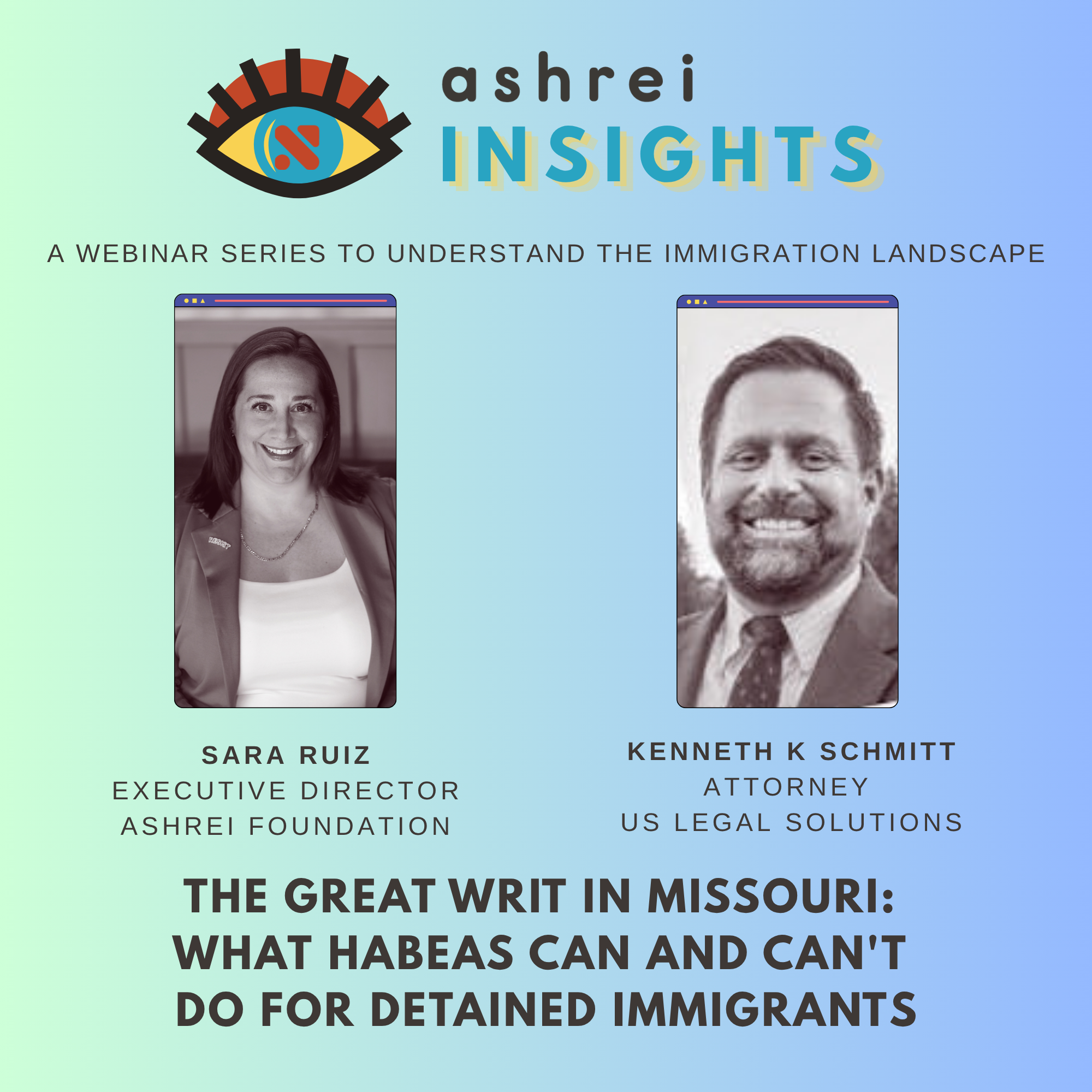
Save the Date for our October Ashrei Insights!
October 28 | 12:00 PM | Zoom
As immigration detention grows across Missouri, families and advocates are asking: Can we take this to federal court?
Attorney Ken Schmitt of US Legal Solutions joins Ashrei Executive Director Sara Ruiz to unpack the growing use of habeas petitions, what they can do, and where their limits lie.
Register, submit your questions, and join the conversation here