

Ashrei hosted an Insights webinar to review the October 2026 update to our Eastern Missouri Immigration Enforcement Data Dashboard and explore what this month's data can teach us about immigration enforcement in Missouri today. This month, I was joined by Meredith Rataj, Ashrei’s new Program Manager for Immigration Justice. Meredith joined us at the end of September after 15 years in immigrant services in St. Louis and four years in reentry work. She brought another dimension to this data: the voices of the families who call the Hotline.
Watch the webinar:
We opened this month’s webinar with two questions:
What are the top 2 questions you have about immigration enforcement in our region right now?
If you had the answers, what would that make possible for you, your congregation, your neighborhood, or your community?
Whether you joined us live or are watching the recording, we invite you to consider how you might respond to these questions.
Ashrei is building this work around what our community needs to know, so your questions can inform the direction of this work moving forward. If you’d like to share, please send us an email!
The Eastern Missouri Immigration Enforcement Dashboard exists because official data about immigration enforcement in our region is insufficient and unreliable, at best. Ashrei and our partners work to design service and advocacy responses based on facts and local realities but we are constantly limited by the absence of reliable, consistent and comprehensive government data. When the government fails to be transparent or accountable, we the people have to document what is really happening ourselves. Building and sharing our own data has become foundational to informing local efforts that advance equity and justice in Missouri.
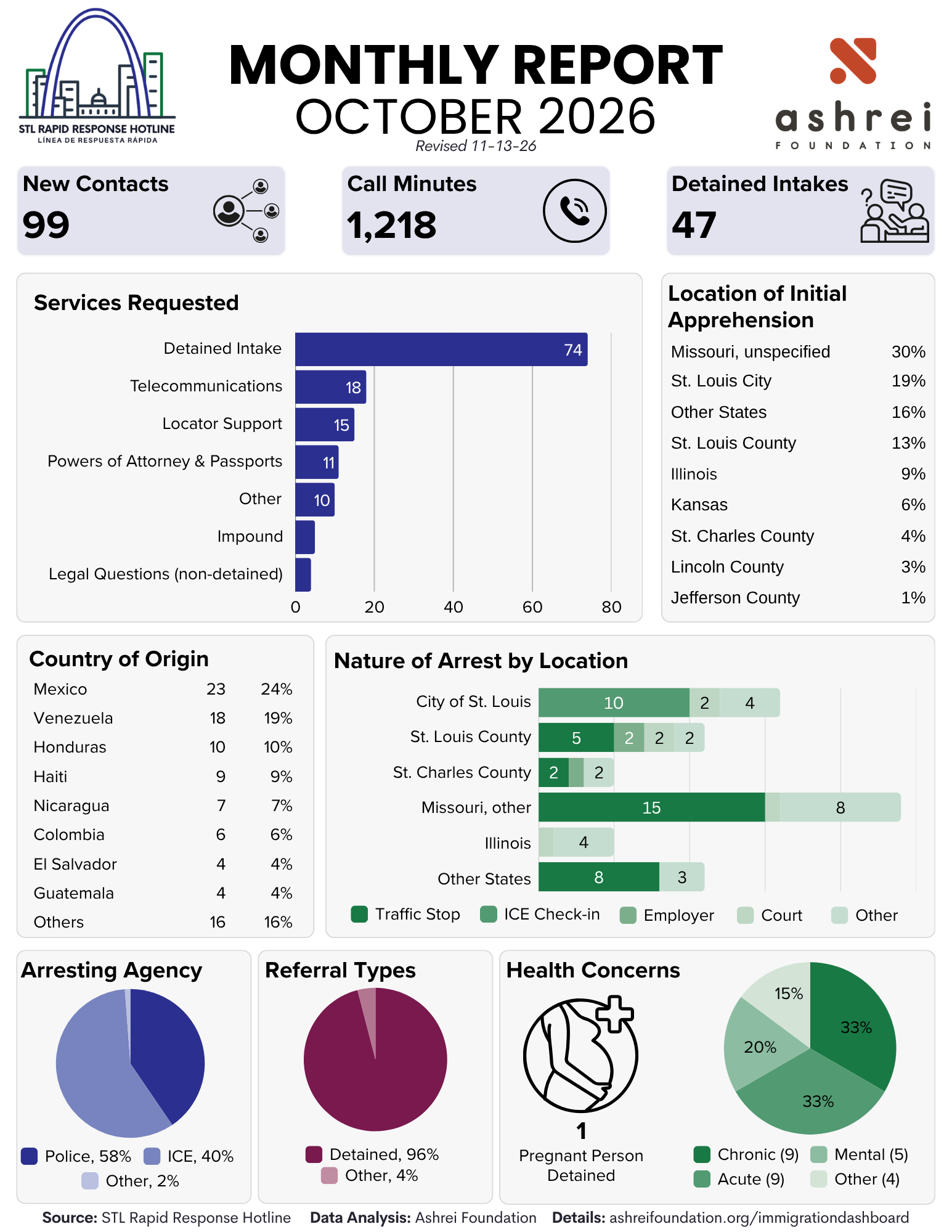
Of course, the STL Rapid Response Hotline did not start as a data project. It started in coalition with multiple community partners to protect the dignity and safety of families impacted by immigration enforcement. Trained volunteers answer calls from 7:00 am to 7:00 pm, seven days a week.
We help families find loved ones who have disappeared into the system and ensure they are able to communicate.
“We offer compassionate, confidential support to families who are navigating complex legal and carceral systems, honoring their dignity by providing as much clarity around current detention and deportation processes. ”
We help get cars out of impound and connect people to existing resources in our community. We can offer most detained people a free, one-time legal consultation, where they can more fully understand if they may have any opportunity to get out of jail or remain in the US. Every person we support helps us see what is happening in our region, as it happens, in ways that federal data can never fully capture.
During the webinar, we walked through some of our data collection methods and displayed the Dashboard while highlighting a few facts that stand out from the last couple months:
Volume
In September, the Hotline received 93 referrals; in October, 99. That is almost double the quantity of people from the same time last year. Some of that growth is because more people know about the Hotline. But it also tracks with the rising enforcement patterns in federal data. Enforcement moves in peaks and valleys: a month that appears to be lower than the prior month and is not sufficient to indicate a downward trend. Last year, numbers dipped moving into November and then climbed again in December and January. We expect to see that pattern again and we anticipate increased enforcement over the coming weeks.
Meredith described what this feels like on the line: busy. We often receive more calls than one volunteer can answer in a shift. It is also marked by increased confusion. Many families tell us their loved one had an open asylum case or a work permit. They thought they were doing everything right. But now, their loved one is detained and they don’t understand why.
Tools for Detention
Police are still the largest source of arrests that lead to ICE custody in our region. Traffic stops are still the most common way it happens.
But we noticed a shift this fall: In September, ICE made about 30% of the arrests we recorded; but in October, that jumped to about 40%. Police didn’t arrest fewer people, but ICE arrested more. We received reports about more arrests in public, outside courthouses, and several made at Lambert International Airport in St. Louis.
One man shared with the Hotline that police told him they pulled him over because he “crossed a white line.” He was pulled over, arrested, detained, and transferred to ICE. His car was impounded in another state. His wife, with young children and no job, lost the family’s main income and their only car in a single afternoon. Meredith also described how often our callers’ loved ones are detained after a flat tire or a car accident. When most of us are stranded on the side of the road, we expect the police to help, but that is not what happens for the families who call us.
One more note: a year ago, we recorded how an arrest happened on about 30% of calls. Today, it’s more than 95%! That is the work of trained volunteers asking careful questions in hard moments and capturing data with care. Thank you, volunteers!
Country of Origin
Mexico, Venezuela, and Honduras continue to trade places at the top of our country-of-origin data. But one change stands out: in June and July, we didn’t have any records of detained Haitians. However, in September, we recorded eight; in October, nine. Haiti is now the fourth-largest group of impacted immigrants we serve.
This follows the end of Temporary Protected Status for Haiti. People who had legal status lost it, and enforcement followed.
This shift has been challenging for us, since most of our Operators speak Spanish and English, not Haitian Creole. To fill the gap and meet the need, we are paying for interpretation services and using free online tools when possible. One Haitian woman was desperate for help for her husband and was vulnerable to scams as she searched for an attorney she couldn’t afford. With help from Abide in Love volunteers, including a Haitian Creole speaker, our team connected her with someone who could talk through these complicated decisions in her language. It was a hard conversation. His legal options were limited. But she now has accurate information to make decisions for her family.
Health Concerns
NEW: For the first time, our monthly and cumulative reports include information about the health of people in ICE custody. We started tracking this information because we kept hearing it: people unable to get medication, people detained while recovering from surgery, people experiencing mental health crises, and people who are pregnant. There was no public record of any of it. I’m grateful to David Garcia, one of our summer interns through Washington University’s Gephardt Institute, whose contributions laid the foundation for this work.
About one in three people we screened identified a health concern. Two-thirds of those were related to conditions they were already managing before detention. Less than 20% reported mental health concerns, but we are confident that number radically under-reports reality. Our volunteers are community members, not crisis counselors. And it isn’t easy to tell a stranger what you’re struggling with, or to find words for it in a second language. As a result, we are building and sourcing additional materials, resources and training for volunteers to improve our ability to respond.
Then, there is pregnancy. The Hotline has supported at least 14 people who were pregnant, had given birth in the last year, or were nursing while detained. None of these women were held for less than two weeks; two women are still detained, both in their third month in ICE custody. Many of us assume there are rules that keep pregnant people out of jail. In practice, that is not the reality. We are working with national partners who are studying this, advocating for change and utilizing legal challenges to hold ICE accountable to its own directives that would ensure pregnant women are not put in jail.
Unfortunately, when we identify a health concern, there is no clear path to fix it. Detention in Missouri happens in county jails. ICE won’t share information without an attorney of record. In some circumstances, when we’ve been able to communicate with jail staff, care improved, but it has never been enough. We are mindful that none of this happens in a vacuum. ICE detention and abysmal conditions in these jails is part of the larger system of mass incarceration that treats people unacceptably every day.
Family Needs
Most families and detained people still ask for the same thing first: to talk to an attorney. Many also need help navigating the private telecommunications apps that control whether they can talk to a detained loved one. In October, more families asked for help with powers of attorney and other notarized documents.
Those documents matter. Meredith told us about a wife with a notarized letter from her detained husband authorizing her to retrieve their car. The impound lot turned her away again and again. Another family only got their car back because an Abide in Love volunteer refused to leave until they did. Every day a car sits in impound, the fees grow. Eventually the car isn’t worth what it costs to get it out.
The purpose of collecting and sharing this data is not simply to observe what is happening - it is to strengthen community efforts that alleviate suffering, improve community response systems, and inform advocacy aimed at protecting families and upholding human dignity.
Take Action
Use this data. It is public so you can share it, cite it, and act on it. Our Data Details page explains every field, how we calculate it, and when we started collecting it. Several blog posts (like this one) share stories of real people that the Hotline has supported.
Download the monthly reports and share them with someone you know.
Include them in your next postcard, phone call or email to your elected leaders!
If your municipality or police department disputes these numbers, our response to them is simple: publish your own data! Tell us who you arrest and why. Tell us when you honor voluntary ICE detainer requests and administrative warrants. If that data were public, we could shift our capacity elsewhere to address the impacts and harm increased enforcement is causing in our communities.
We need YOU to join our volunteer team! Volunteer as a hotline operator (bilingual), daily lead, or volunteer attorney. Click here to take the first step.
We also encourage you to connect with the MICA Project’s community defense groups, which are organizing locally against surveillance cameras and 287(g) agreements. Visit our Community Calendar for what’s next.
This work requires ongoing capacity to maintain and improve systems, train and equip volunteers, analyze and present data, and more. We are building power to shift these systems towards dignity, equity and love. Power is organized people and organized money. Please consider financially supporting the Ashrei Foundation.
Explore the dashboard: https://www.ashreifoundation.org/immigrationdashboard
Remember: Ashrei's dashboard reflects incidents reported through the STL Rapid Response Hotline and therefore represents only a portion of the broader enforcement landscape in Missouri. It offers an important window into trends that might otherwise remain invisible. Please consider this data alongside other sources and understand it as part of this broader context.
Together, we can transform information into understanding, understanding into action, and heal Missouri rooted justice and dignity.
Continue learning with us!
Save the Date for our January 2027 Ashrei Insights Webinar!
January 27 | 12:00 PM | Zoom