
We Hear the Cry: Stories from the Rapid Response Hotline
On August 17, clergy, faith leaders, and neighbors from across St. Louis gathered on the public sidewalk outside the St. Louis ICE office for “We Hear the Cry,” an Interfaith Vigil for Immigrant Justice. Across traditions, sacred texts and stories from the STL Rapid Response Hotline were read aloud. Together, we prayed, sang, and kept silence for people held in immigration detention in Missouri, and for the families waiting for them to come home.
See news coverage from First Alert 4 here.
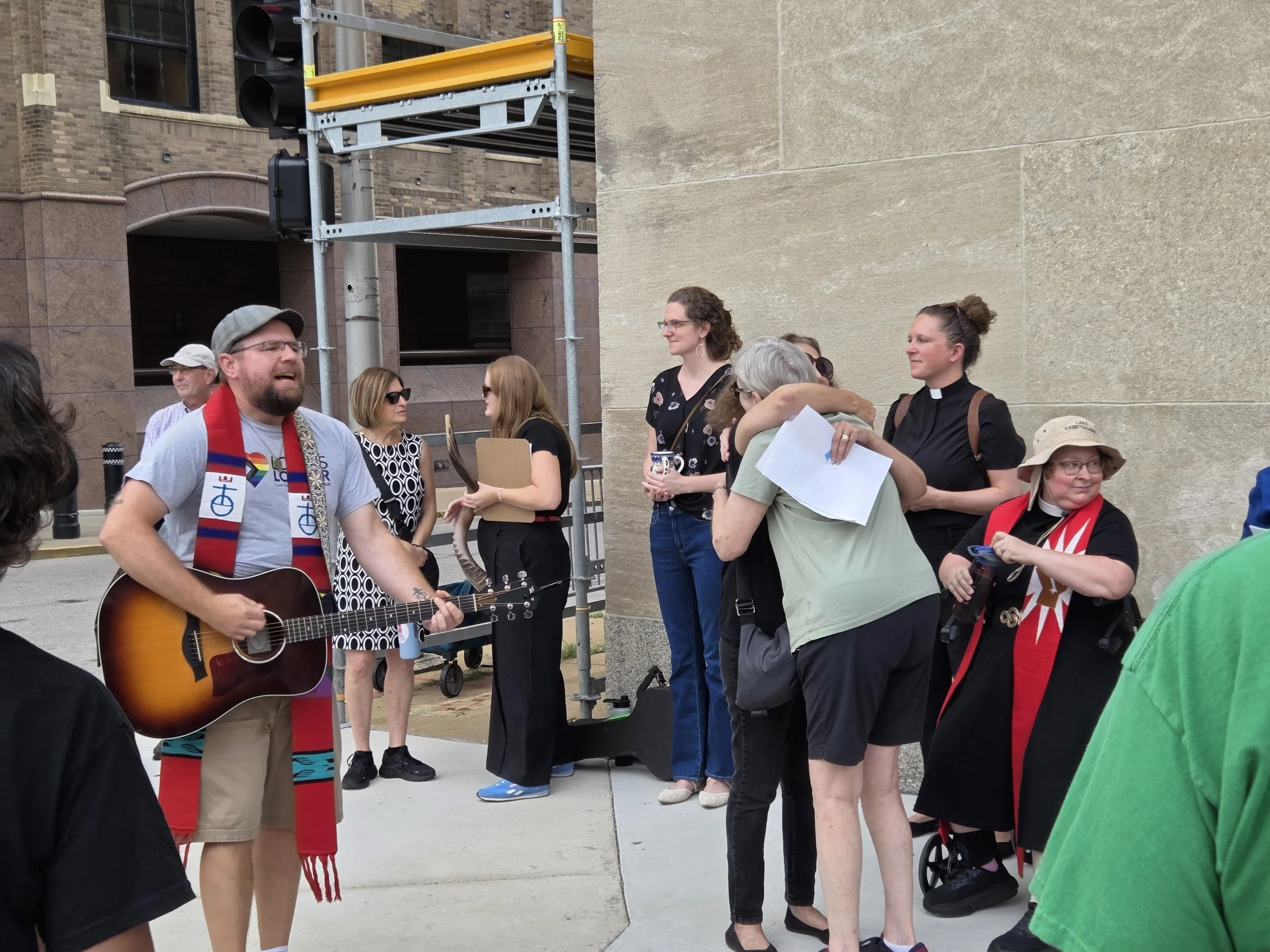
The stories shared that evening were not hypothetical.
They came from real reports made to the Rapid Response Hotline, including conversations with people detained in ICE custody. Identifying information has been removed to protect the people who entrusted volunteers with their experiences.
The names used here are pseudonyms.
What happened to these people is real.
These stories make unmistakably clear that the need for assistance is enormous, while the machinery of immigration enforcement is often brutal, confusing, and deeply isolating.
To facilitate understanding of the evolving landscape of immigration enforcement, Ashrei has developed the Eastern Missouri Immigration Enforcement Dashboard, a monthly report utilizing the data we collect from the hotline. See the report at ashreifoundation.org/immigrationdashboard
When Calling the for Help Leads to Immigration Detention
Camila called the police because her partner was hurting her. He had pulled her to the floor by her hair, slammed her down, and had hurt her many times before. She locked herself and her seven-year-old son in a bathroom and called for help.
The officers who responded never asked about her immigration status. They took statements and separated the couple. Her partner was released the next morning.
Camila was not.
At 5 a.m., she was told there was an ICE hold on her. She was moved from the local system into immigration detention, more than 100 miles from her son. She was pregnant and experiencing severe nausea and headaches, yet weeks passed without the prenatal-care referral she had been promised. Her greatest fear was not deportation. It was that the man who had abused her could find out where she was and use her pregnancy to continue controlling her.
Her story raises a fundamental question: What happens when seeking help from local law enforcement can ultimately lead to immigration detention?
When a Traffic Stop Becomes an ICE Arrest
Aurelio was riding to work with his cousin and three other men when state troopers stopped their car for an expired plate. The troopers wrote tickets and told them they could leave once a licensed driver arrived.
But before that driver could get there, the troopers called ICE.
Seven ICE vehicles arrived. The troopers helped ICE arrest all five men. As Aurelio was driven away, he watched the troopers salute the ICE officers. The ICE officers had no warrant or other papers for any of the men.
Paloma was pulled over while driving to pick up her son from the nursery. She was not violating traffic laws. The officer followed her for a long stretch before turning on his lights, citing her for driving without a license, and arresting her. The next day, ICE took her.
Paloma was breastfeeding her infant, a U.S. citizen. In detention, she pumped milk to be delivered to her baby's father. But she reported that there was not enough drinking water at the facility. She and other women collected water from the shower and boiled it in a microwave. Her milk was drying up. Her children were without her.
These stories show how quickly an ordinary encounter with local law enforcement can become an immigration crisis—and why the entanglement between local policing and ICE matters.
When Detention Becomes a Threat to Health
For people in detention, even basic medical needs can become urgent struggles.
Elmer had undergone surgery for a brain tumor and remained under the care of St. Louis doctors. He takes medication for epilepsy twice a day; if his medication schedule slips, he gets headaches, and if it slips far enough, he is at risk of a seizure.
After ICE detained him, his medication schedule became irregular. One day, despite repeatedly asking, he received none at all. He had only about two weeks of medication remaining and did not know how the jail would obtain more. When he spoke with a Hotline volunteer, he wasn't asking for a lawyer or even for his release.
He asked for someone to make sure he got his pills on time.
Yeremy, who entered the country lawfully through the CBP One app and had a pending asylum case and work permit, was detained while working. He is diabetic. Three weeks into detention, he still had not received his medication despite repeatedly asking and submitting requests.
Wilfredo was detained after a traffic stop while traveling to a construction job. While in detention, he became ill and was eventually told he had an injury that could tear and bleed and required surgery. An immigration judge granted him voluntary departure. He was deported without seeing a doctor.
These are not stories about people asking for special treatment. They are stories about people asking for medication, water, medical care, and the ability to stay connected to their families.
The Violence of an Arrest
Marisol was asleep in a home shared by restaurant workers when agents raided the house. She tried to leave through her bedroom door and was tackled at the threshold. Her hands were cuffed behind her back, and an officer held a gun against her head for several minutes. More than ten vehicles surrounded the house. Drones circled overhead. Some officers wore police uniforms; others wore military-style camouflage.
There was no warrant.
No one spoke Spanish to her. Hours later, agents questioned her about her job and showed her photographs of people she had never seen.
Marisol had come to the United States from Mexico City to escape violence and support her two young children in Mexico. Her wages were the family's only income.
Her question was not about herself.
How long would her family go without her?
Emilio described being surrounded by five unmarked vans and roughly ten armed agents while he and a friend sat in a car outside a shopping center. Agents pulled him from the vehicle, grabbed him by the neck, threw him to the ground, and restrained him with handcuffs and ankle chains connected around his waist. He said agents mocked the two men and one threatened to take his picture “as a trophy.” He had never been arrested or charged with anything in the United States. He was ultimately deported to Mexico.
And then there is Rosa, who called 911 during a fight with her partner. Police arrested her instead. She showed them a video demonstrating that her partner had started the fight. They refused to watch it. At the station, she learned she was pregnant. The next day she began bleeding and was taken to the hospital. While doctors warned that she might lose the pregnancy or that it could be ectopic, ICE took her into custody.
The Need is Bigger than One Hotline Can Meet
The Hotline stories also reveal another layer of vulnerability: people in detention and their families are targets for exploitation.
Mateo's sister paid $3,500 to an immigration lawyer she found online who guaranteed a positive outcome. After receiving the money, the lawyer disappeared. Hotline volunteers confirmed it was a scam.
Osmar's wife paid more than $7,000 to someone who claimed to be an immigration attorney, including money she was told was an immigration bond. There was never a bond, and the supposed attorney eventually stopped responding.
While Yeremy was detained, his wife received calls from people claiming to be an immigration attorney, an FBI agent, and someone who could get her husband released if she sent money. Each time, Hotline volunteers helped verify that the claims were fraudulent.
Families navigating detention are often doing so with little information, limited resources, and enormous fear. That makes them particularly vulnerable to people who exploit their desperation.
We Hear the Cry
There are also stories of what becomes possible when someone has an advocate.
Renata, a longtime lawful permanent resident and mother, was detained at Lambert Airport after returning from Mexico. She had her valid green card with her. She was transferred to a Missouri jail and held for weeks.
Eventually, her family reached the Hotline. A volunteer attorney met with her and identified a potentially viable legal path. Her family found an immigration attorney who helped her file the necessary application and evidence. An immigration judge ultimately granted her application, and Renata was released and reunited with her family.
That story matters because it demonstrates what assistance can mean: information when someone is isolated, advocacy when a person cannot advocate for themselves, and a lifeline for families navigating a system they cannot navigate alone.
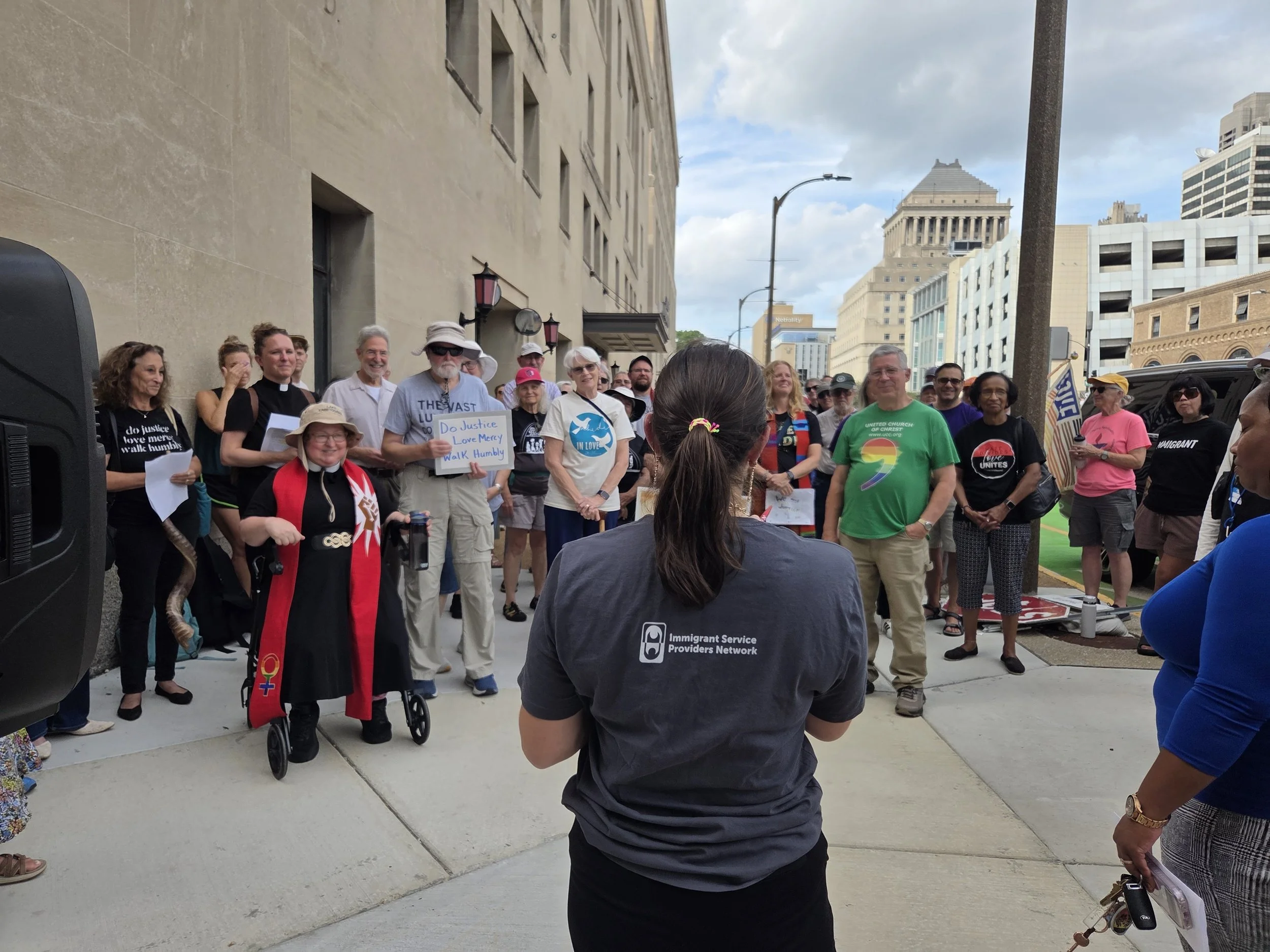
At the August 17 vigil, these stories were placed alongside sacred texts from multiple faith traditions. Their presence on the sidewalk outside the ICE office was itself an act of witness.
We gathered because behind every statistic is a person. Behind every detention bed is a family waiting. Behind every arrest is a story, a history, a child, a parent, a partner, a community.
And we gathered to make clear that we are listening.
The “We Hear the Cry” Interfaith Vigil for Immigrant Justice amplified calls for meaningful oversight of immigration detention and for an end to the entanglement of local police with ICE. These stories show why those calls matter.
We hear the cry of people asking for medicine.
We hear the cry of parents separated from their children.
We hear the cry of survivors who called for help.
We hear the cry of families facing fear, confusion, and exploitation.
And we hear the cry for dignity, accountability, and justice.
The work of the Rapid Response Hotline is to answer that cry with practical help and to make sure that the people who are detained are not forgotten.
To learn more about the Hotline and how to help, visit https://www.ashreifoundation.org/rapid-response