
From Promise to Practice: A reflection on the vigil for Glendy & Nixon
By Sara Ruiz, Ashrei Foundation Executive Director
On Sunday August 2nd, I stood outside Overland City Hall with hundreds of neighbors that responded to a request from our partners at MO Workers Center: join us to grieve in public, to continue the hard work of organizing, and to demand accountability. We were there to say the names of Glendy González de la Cruz and Nixon Pérez Paz out loud, together, so they would not be reduced to a headline.
Nixon was deported last year after ICE agents working in Overland made a traffic stop that led to this devastation. Glendy, still pursuing an active asylum case, made one of the hardest decisions a mother can make: she took their three young daughters and followed her husband back to Guatemala rather than face the daily fear of being separated from him and the now overwhelming financial burden deportation leaves in its wake. Weeks later, both parents were found bound and shot to death in a sugarcane field in Guatemala; their youngest daughter was found crying beside her mother's body.
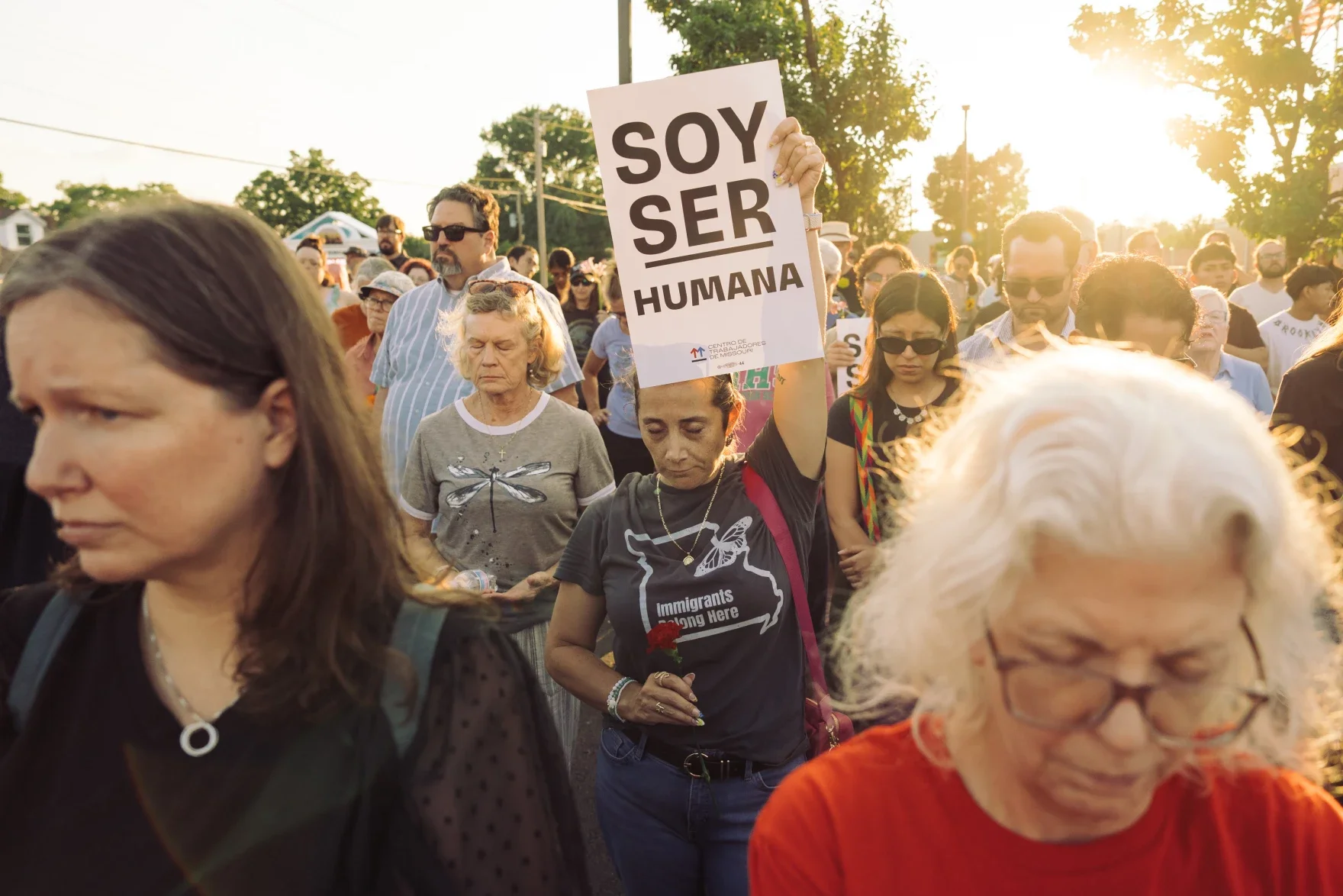
Sara Ruiz, executive director of the Ashrei Foundation at center, holds up a sign that reads, “I am a human being” while mourning former Overland residents Glendy González de la Cruz and Nixon Pérez Paz during a vigil outside Overland City Hall on Sunday.
I stood among the crowd at Sunday’s vigil, holding a sign that read, "I am a human being." A simple, direct, message that speaks to the very core of what is at stake in our communities - and the heart of Ashrei’s mission. As a mother, I don't have the words to make this loss make sense, because it simply does not. I keep asking myself the same question we asked two years ago: what will it take, so that when we look back, we can say we did everything we could to protect the dignity of all people? In the last 2 years, we’ve learned, observed, and practiced a few things that help us answer that question.
Showing up
Change requires power; power is organized people and organized money. To have enough people power means having enough individuals that identify shared values, accept disagreement, and show up consistently together united in a vision for a different future. Sunday’s vigil was a beautiful demonstration of precisely that: hundreds of people came out to support a family many of them never met and listened to immigrant leaders in our community demand accountability. Then, we saw elected officials stand up in public and said something rarely said out loud in North County: that immigration enforcement does not make our communities safer.
Collaboration
Doing everything we can means staying focused on our common ground, relentlessly pursuing the changes needed so that our shared values can become the standard in our community. The powerful, diverse, unique crowd that gathered happened because of the incredible leadership of several people, including Vanessa Henriquez (organizer at MO Workers Center), Milton and other leaders at Fuerza, Rev. Erika Gravely and other faith leaders, Dr. Chris Kilbride (superintendent of Ritenour school district) and teachers in the district who are now front line responders to the harmful impacts of enforcement, and other community partners that refuse to let stories of injustice fade into silence. Collaboration requires deep trust, profound humility, active learning and patient resilience. Ashrei was honored to stand with so many organizational partners in the crowd that have been doing this hard, intentional work.
Accountability
Recentering our government, institutions, laws, policies and practices on human dignity is no small order. It will not happen all at once or right away. It is a movement that must be built and sustained, until we are powerful enough to bring about change. Public commitments like those we heard on Sunday are valuable and important – and they are not the end; words are not the win we seek. Overland does not have an active 287(g) agreement. And yet, Overland has been collaborating with ICE this whole time, without ever needing a formal agreement to do so. A commitment from the mayor not to enter into a 287(g) agreement is valuable. And. It changes nothing about how Nixon and countless others end up in ICE custody in the first place.
Across Ashrei's Rapid Response Hotline data, local police — not ICE agents — are the arresting agency in roughly 60% of cases – more than double those that end up in ICE detention because of ICE enforcement actions. A routine traffic stop. A welfare check. A call for help that turns victims into detainees. A racially motivated opportunity to question someone on the street. Local police are ICE's primary muscle in this region, agreement or no agreement, because the agreement was never the mechanism doing the harm.
The mayor's statement should have been met with cheers, as we all reacted on Sunday; it is worth celebrating. And. We should be cautious to avoid mistaking a costless verbal promise for a change in practice that truly protects our communities. A 287(g) refusal doesn't touch racial profiling, traffic stops, welfare checks, or the routine data-sharing that actually funnels people into immigration detention. Real accountability from Overland — or anywhere else — looks like transparency about the arrests and handoffs already happening, an actual end to local collaboration with ICE in practice, and public data that proves immigrants are safe. Accountability is up to all of us.
Turning Memories into Blessings
Transparency creates visibility, and visibility is often the first step toward accountability — but a promise is not transparency, and it's not accountability either. What happens if we let a mayor's word be the end of the story? How will the next family be treated if a costless "no" is enough to send everyone home satisfied? We believe there is only one answer: every department, every locality across our region needs to be measured by what it's actually doing — not by public statements and verbal niceties. We all must demand real transparency about arrests and ICE handoffs, and an actual end to local collaboration in practice, from Overland and from every department in the region. We stay. We watch. We keep showing up, alongside the organizers and the families who made Sunday possible, and in collaboration with multiple organizations in our region that must be successful in order for all of us to succeed. And we must sustain this movement for dignity and justice for as long as it takes.
We came together to grieve two people who deserved to grow old with their daughters. Let's not let their names become a headline that fades. Let's hold this community, and each other, to something better — courageously, over and over again. Glendy and Nixon, may their memories be a blessing.